A journey of faith: my burning questions (part 2)
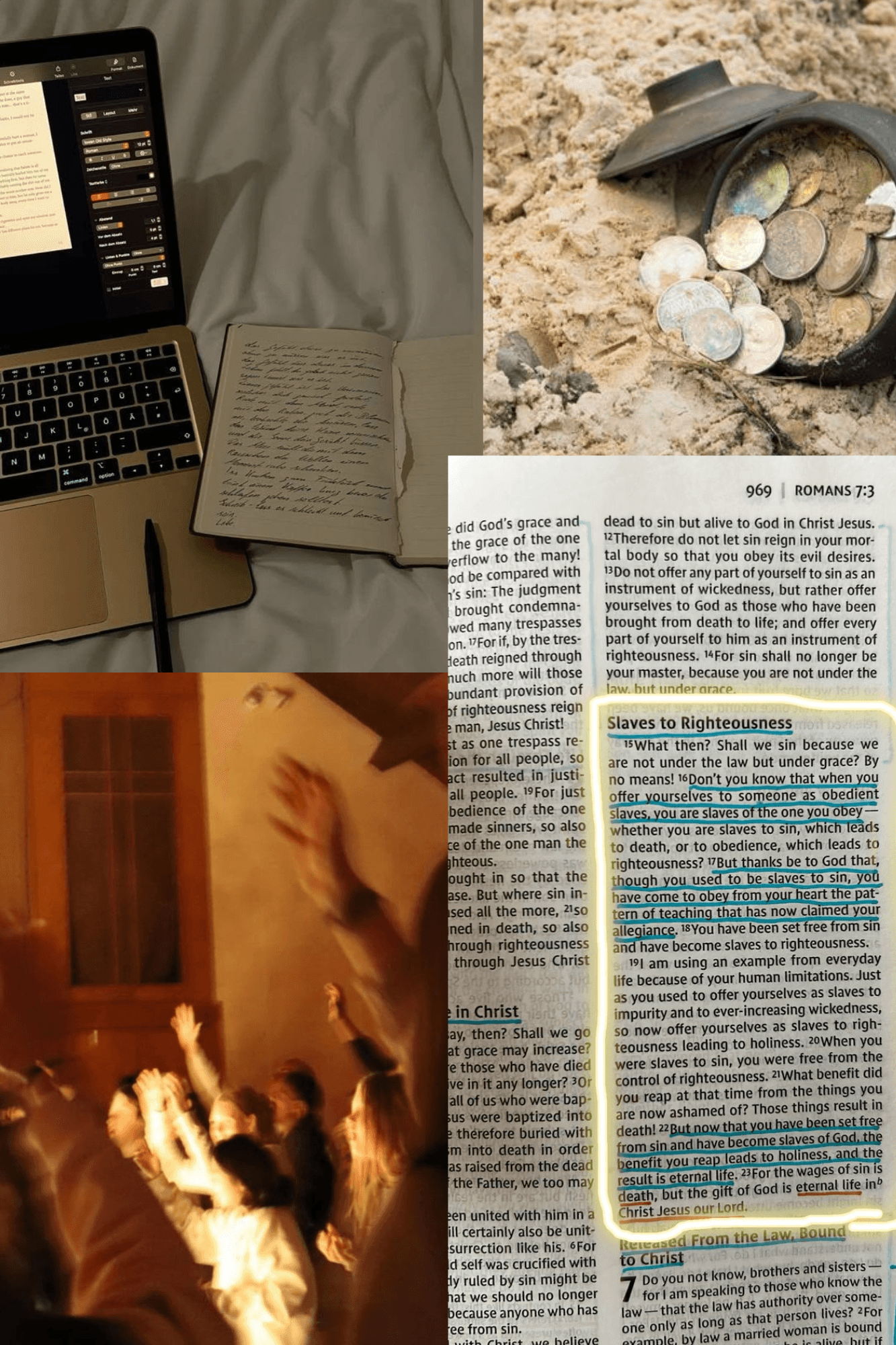
I wrote the first “burning questions” installment almost eight months ago. Without getting into any details, a lot has changed. My life looks very different. I’ve read, pondered, and learned a lot. And yet I’m sure no one will be shocked to hear that, despite all my studying, I still have questions – tons, in fact. So without further delay, here are the questions currently taking up the most space in my mental pie chart:
What does it mean to be in spirit / the Spirit?
At one of the first church services I attended as a new believer, the pastor’s sermon revolved around balance between “Spirit and Truth.” Originating from Jesus’s conversation with the Samaritan woman in John chapter 4, the concept initially registered as pretty straightforward.
However, the more I’ve thought about this, the less straightforward it’s become.
In John 4:24 (ESV, NKJV, TS2009), Jesus tells the Samaritan woman that worshipers of the Lord must do so “in spirit and truth”. In the NIV translation, this verse reads, “in the Spirit and truth.” By the difference in capitalization, the implied meanings could be slightly different (Greek word pneuma translated as the Holy Spirit vs human spirit).
Since that pastor used the NIV translation, let’s start there. To start thinking about being “in the Spirit,” I gathered a few verses to add some color.
In Romans 8:9 (ESV), Paul reminds the Roman church that they are no longer “in the flesh but in the Spirit, if in fact the Spirit of God dwells in [them].” He also instructs the Galatians to “walk by…”, “live by…”, and “keep in step with the Spirit” (Galatians 5:16, 25 ESV).
Looking first at Romans 8:9, my immediate thought is of bidirectional if and only if statements from my mathematical proofs class. If the spirit of God dwells in us, then we are in the Spirit, and if we are in the Spirit, then the spirit of God must dwell in us. So, in that sense, it’s clear what is required to be “in the Spirit”: Jesus promised to send His Advocate, the Holy Spirit, upon His death, to be received by all believers through their faith in Him (John 14:26). But what does it mean to walk by that Spirit? To live by it?
Perhaps it’s not unreasonable to conclude that Paul’s verses are another way of telling us to live a Spirit-led life. Easier said than done, I know. I’m admittedly still figuring out what that looks like for me as I learn to discern the Holy Spirit’s voice. But, in principle, I can understand it.
In stark contrast, worshipping in the Spirit has thrown me for a bit of a loop. Are we being pointed toward Spirit-led worship? If so, what does that look like? Is it a call toward a spiritual, emotional, individual experience? Or perhaps it’s intended to encourage corporate worship with others who are in the Spirit, aka our brothers and sisters in whom the Spirit of God also dwells, aka the church body?
And then, to add more layers to my question, there’s the other translations featuring “spirit” with a lowercase “s”.
I think it’s reasonable to say that most of us have some understanding of the phrase “in spirit”, at least in accordance with the modern use. To give a biblical example, in Acts 18:25 (ESV), a Jew named Apollos is spoken of as “fervent in spirit [as] he spoke and taught accurately the things concerning Jesus.” Another good example is Psalm 34:18 (ESV), one of my favorite verses: “The Lord is near to the brokenhearted and saves the crushed in spirit.” In these cases, the term “in spirit” essentially refers to the person’s disposition or state at that time.
If we apply that same meaning to the verse in John 4, worshipping “in spirit” could refer more to our heart posture during worship. Does our intention and internal state of being reflect true love and reverence for the Almighty God? Is our focus entirely on the Lord and His goodness? Or maybe it’s referring to our new spiritual access to the Lord, which wasn’t available before Christ? No longer was worship restricted to a particular location or a certain group of people; everyone could worship the Lord freely with their very soul.
Needless to say, I’m still unsure what exactly is meant by “spirit and truth”. But I’ll keep studying and, if the Lord means for me to understand it, the Holy Spirit within me will teach me what I need to know.
What does “identity” look like in the Christian life?
Over the last few months or so, I’ve been writing a lot less. One could say that I’ve lacked inspiration.
A few days ago, I was driving by myself and thinking about this creative lull. I decided to talk to God about it; I confided in Him that I was worried because, other than writing, I didn’t feel like I had any other skills that I could use to serve the Kingdom. As I spoke about it, I started wondering about the concept of “identity”.
In the typical non-Christian sense, our identities are made up by all kinds of things – career, hobbies, interests, traits, relationships, preferences, values, etc. But as Christians we know that when we place our faith in Christ, we become new creations and are therefore given new identities in Him (2 Corinthians 5:17). In the same vein, we also know that we are crucified along with Him, such that “it is no longer [us] who live, but Christ who lives in [us]” (Galatians 2:20).
Here’s how this knowledge relates to my original thought: There I was, crying to the Lord and feeling sad because maybe His plan isn’t to use me through my writing. But why would that make me sad unless I was placing some part of my value in my identity as a writer?
Furthermore, we know that God bestows each of us with gifts, talents, and traits, according to His perfect will. Our job is to steward those gifts in such a way that “in everything God may be glorified through Jesus Christ” (1 Peter 4:10 ESV). *The Parable of the Talents also comes to mind (Matthew 25:14-30).* So if we know that God gives these gifts to His people, then my question that follows is this: Are we allowed to identify with those gifts? Can our perception of self be influenced by the way that we serve the Lord?
If the Lord has equipped me with a particular skill in writing (emphasis on IF; I am not saying that He has!!), then is it okay to consider that a part of my identity, so long as it is secondary to my identity as a servant of the Lord? Can how we serve be a part of who we are, as long as it doesn’t overshadow who we serve?
What authority are we given through Christ?
I recently came across a YouTube video by a Christian creator named Naomi Bell. The video is titled “pov: you realize overcoming sin was never about trying harder”.
Though a good chunk of the video is devoted to lifestyle vlog-type content, there’s portion of it dedicated to a discussion about the Christian walk – more specifically, the victory that we walk in as new creations in Christ and what our relationship with sin becomes – that got me thinking.
The creator expresses her disagreement with the perception that Christians will continue to struggle with sin throughout their lives, citing that Jesus wouldn’t have told us to follow Him (Matthew 4:19, Luke 9:23, John 12:26, and others) if “He wasn’t able to be followed [and] if His life was not able to be replicated” (time stamp 4m 57s).
A bit later, she discusses our freedom from and dominion over sin. She states that, once we are born of God, our nature, which was once sinful, is changed (time stamp 7m 11s). So, by her understanding, Christ’s death did even more than just reconcile us to God; His crucifixion, and ours along with Him, made us new creations who become the righteousness of God (here she cites 2 Corinthians 5:21) with authority over sin.
I have no intention of arguing with this creator; in fact, I’m quite intrigued by what she said. Truthfully, I hadn’t thought too much about what authority we’re given when we put our faith in the Lord. I’ve considered the human condition – our fallenness, our sick and deceitful hearts, our separation from God – and meditated on the necessity of salvation. I’ve thought about the call to follow Jesus and the armor of God we put on. But how does that change our relationship with sin, other than knowing that it has been atoned for?
When I read that we are no longer slaves to sin (Romans 6:17-18), I’ve always considered it from these perspectives: 1) sin does not determine our eternal fate and 2) we are given strength in Christ Jesus to resist the temptation to sin. But if what Naomi said is correct, that may not be the full picture.
I haven’t gotten to dig into the question as much as the others yet, but it’s certainly on my radar. What does it really mean to be free from sin? If our nature, our very being, is changed to take on the righteousness of God, then why do faithful Christians still struggle? Why do we still sin? How does sanctification tie into that change in our nature?
In my mind, it all ties back to that initial question of authority: when we put our faith in Christ, when we put on the armor of the Lord, what authority are we granted through Him?